
Regulating your Nervous System: What it Means & Why it Matters

Auf Deutsch: Dein Nervensystem regulieren
I’m sure you’ve come across it at some point on your journey: a class, a text, a video that emphasises the importance of nervous system regulation - or, to put it simply, to be more relaxed, stress-free and/or present in your body, your surroundings and with your inner voice. And even though the practices often shared with nervous system regulation in mind are great, we don’t always go much deeper within these reels and captions as to what it actually is we’re trying to do, or where we’re trying to get to - and why it even matters. Understanding the lay-out of the nervous system within our physical body (and beyond), and the intricacies of how it works, offers us the opportunity to get to know ourselves, our patterns, our emotions, our thoughts and our needs even better - and therefore, we are able to support ourselves through the ups and downs of life even more.
This blogpost is a summary of the video that you can find on Unfold under the category “Beyond the Shape”
So, let us start by exploring what the nervous system actually is and how it works. The nervous system is the body’s communication and control network ad it allows the body to sense, to think and to act. View it as the body’s original internet: a vast, intricate web of signals moving faster than thought. This web is connecting your muscles, to your brain, to your immune system, your digestive system, your hormonal system, your lymphatic system… All of these systems and functions are in constant communication with each other through the nervous system. The nervous system allows us to move our body, to feel something on our skin, and it makes sure our heart continues to beat (to name a few things). Some of these things, we’re in control of. Some of these things happen involuntarily. Most importantly, everything in the body is being orchestrated by your nervous system. Every signal, every sensation, and every voluntary and involuntary function happening right now in your body: you’ve got your nervous system to thank for it.
This is why, then, a disregulated nervous system state can have such a vast affect on ourselves and our bodily functions. The quality of sleep you’re getting, your immunity, your digestion, and your capacity to feel joy and happiness (again, to name just a few) - all of this is affected by how well your nervous system is able to function.
The Nervous System mapped out
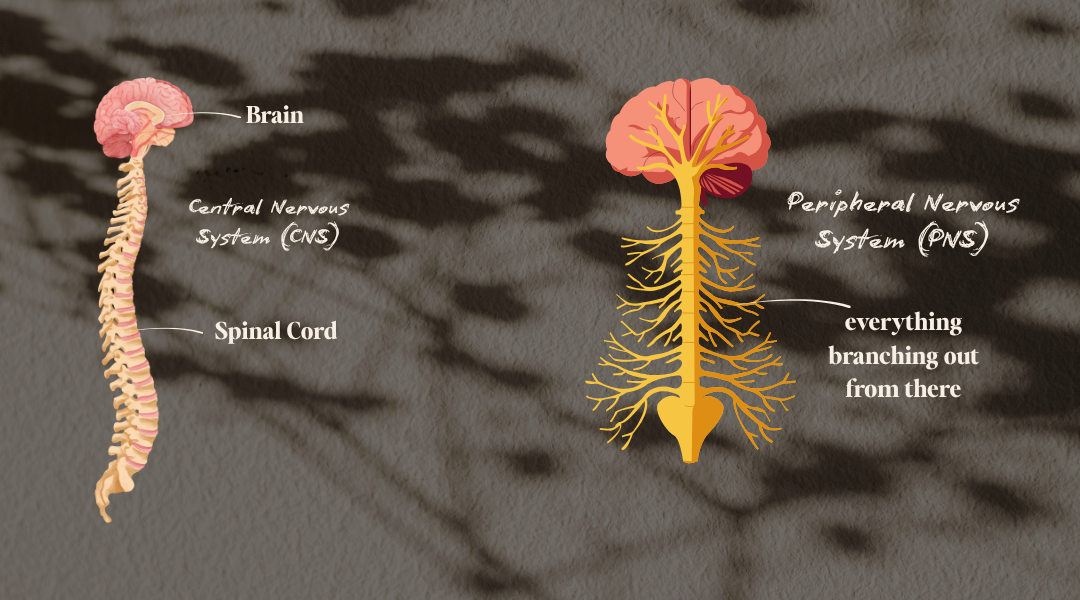
Time to get a little anatomical! It’s important to know that the nervous system divides into two main branches:
Central Nervous System (CNS).
This consists of the brain and the spinal cord. This is the body’s processing centre: it receives, interprets, and responds to information and coordinates activity in the body. See this as the trunk of a tree: the solid base from which things can grow.Peripheral Nervous System (PNS)
This consists of everything that is branching out from the CNS. From the spinal cord, there are branches of nerves that move out into every single layer of the body, reaching every organ, limb and layer of skin. This is the messenger network.
See this as the roots and branches of the tree: gathering information and connecting itself to the outside world.
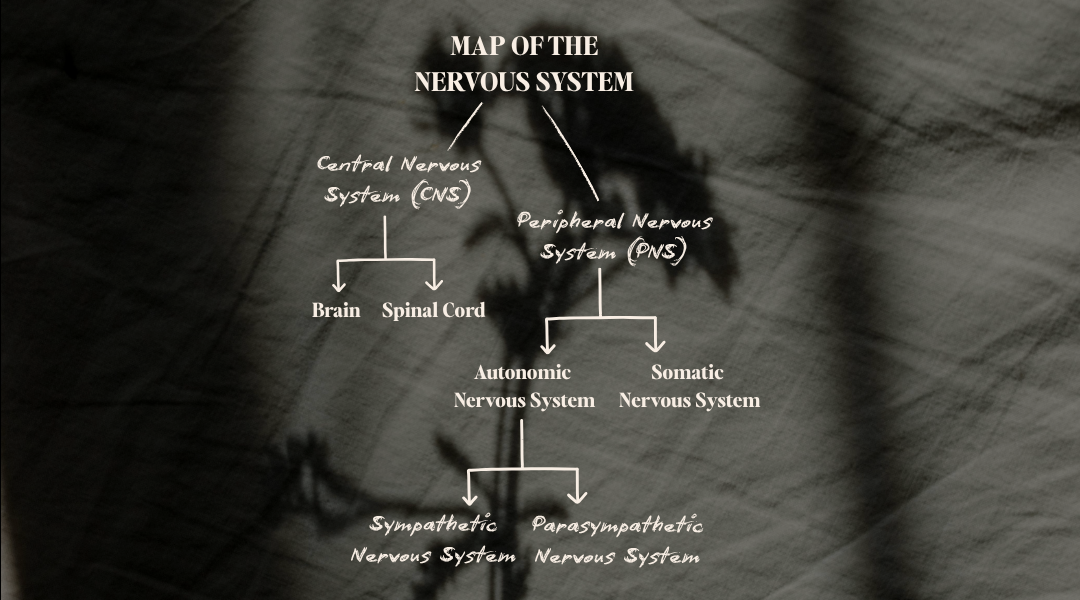
You still with me? OK good, let’s go a little deeper. Within the Peripheral Nervous System, we have two further branches:
Somatic Nervous System
You’ve probably heard of the word ‘soma’, which means body. The somatic nervous system guides your voluntary movement, so when you choose to lift your arm, or look around you, for example.Autonomic Nervous System (ANS)
This is the part of your nervous system that guides the involuntary functions within the body. Autonomic literally means ‘self-governing’.We do not need to think of these things consciously for them to happen - they do not need our permission to be activated. Think: your heartbeat, your digestion, your pupil dilation, and your stress response. This part of our nervous system (that we do not have any control over) again branches out, into:Sympathetic Nervous System
This part is often described as our ‘fight/flight’ response. This is when our body is preparing for action in response to stress, danger or high effort activity (such as running). When we talk about the nervous system being ‘active’, we are describing the sympathetic state. The signals your body can give you when you’re in this state, include increased heart rate & blood pressure, redirection of blood flow to skeletal muscles, dilated airways (for increased oxygen intake), a slowing down of digestion and a state of being (hyper)alert.Parasympathetic Nervous System
This part is often described as our ‘rest/digest’ response, and it is active during calm(er) startes, supporting recovery, relaxation and bodily maintenance. This state calms the mind and the body, and your bodily responses mirror this: your heart rate slows down, your digestion and nutrient absorption return to a supported, productive state, and energy storage and tissue repairs improve.
You are, most likely, most familiar with these two states, as they are most often talked about in popular texts and Yoga classes. And, there’s more nuance to this too, which is helpful to explore when it comes to learning to support yourself in moments of disregulation.
Dr. Stephen Porges developed the Polyvagal theory, which offers a deeper understanding of the full range of responses that live within the two branches of sympathetic and parasympathetic nervous system responses. It makes the way we may view our automatic nervous system responses a little less black and white, and thus offers us a wider range of experiencing, and working with, the nervous system.
So, Porges argues that within the sympathetic state, there are actually four survival responses, not just two:
Fight: This state mobilises you toward the threat, the ‘confront’ response
Flight: This state mobilises you away from the threat, the ‘escape’ response
Freeze (functional/active freeze): The body is flooded with sympathetic activation but becomes immobilised: think of a deer in headlights. So, there’s a sense of high arousal on the inside, but an inability to act on the outside. This may feel like anxiety with paralysis, racing heart but total inability to move or speak, and/or feeling stuck.
Fawn: This response speaks to any people-pleasing tendencies we have in order to stay safe. This is still an active, mobilised response, because the nervous system is doing something to manage the threat. This may look like chronic difficulty saying no, feeling responsible for everyone else's emotional state, losing touch with your own needs and shrinking yourself in any type of way for the comfort of others.
Within the parasympathetic state, there are two very different experiences:
Ventral vagal, true rest and digest: This is the state of genuine safety, connection, and restoration. The body can repair, digest, connect, and be present.
Dorsal vagal, shutdown and collapse: This is the oldest survival mechanism we have and it activates when a threat feels completely inescapable. The system doesn't fight, flee, or appease, but it shuts down entirely. In this state, your heart rate will drop and the body may become heavy and still. Dissociation can occur, which is a a sense of leaving the body or watching yourself from a distance. There may also be a sense of emotional numbness, profound fatigue and/ or feeling checked out or empty. The important thing to note here is that this is often misread as relaxation, but it is not rest. It is the body in a state of overwhelm and collapse.

So, what may we perceive as a healthy, regulated nervous system? In the wellness world, there is such an emphasis on down regulating the nervous system - which essentially is bringing ourselves into a parasympathetic state. And yes, we do live in a wildly overstimulating world, and down regulation is therefore incredibly important. However, what we truly need to feel regulated and in tune with our bodily and emotional needs, is to create nervous system flexibility. We are not endlessly seeking a ‘calm’ nervous system: it is not an end station to arrive at. You want to be able to be in an activated state from time to time (for instance when you go for a run) and to be able to move out of this when the time comes (and not stay with an increased heart rate that won’t go down, and affects your quality of sleep, for example). This fluctuation is incredibly important for the dynamic quality of system.
The issue is, is that for many of us the activated state becomes our default. This chronic sympathetic activation is so prevalent nowadays because of the constant stream of notifications, deadlines, unprocessed stress, lack of pressure, access to worldwide news outlets and other forms of continuous overstimulation. The body never quite gets the signal that it’s safe to relax, to rest, to come down. Then, over time, this type of activation becomes our baseline and being in a restful state becomes unfamiliar, and sometimes even unsafe. Have you ever gone to a Yin or Restorative Yoga class - or something similar - and felt even less relaxed during and after the class than before? This might have been your nervous system thinking it was very unsafe to slow down, and to be with your thoughts, and your feelings, and your sensations. This is common, but not normal. Us rushing from deadline to obligation and squeezing in our ‘self care’ as yet another to do - often at the bottom of our list - is not normal (but common). Us subconsciously checking our phone constantly when spending time with a friend or family is not normal (but common). Us needing certain substances or medication to sleep, socialise, feel energised or wind down is not normal (but common). This is not about shaming you into believing you’re doing something wrong. You’re not in the wrong here, society is. What we just described are some of the many ways in which we are trying to function in a society that has normalised constant input and productivity and is, consequently, an unhealthy place to exist within. But we can’t really escape it either, at least not until we bring into our consciousness the automatic patterns stored in our bodily systems, that emphasise and sustain society’s norms.
These automatic patterns that affirm society’s unhealthy pace and expectations are part of the ‘low level’ chronic activation that we’ve touched on. Chronic activation works in many ways, sometimes so subtle that we don’t even realise it is our norm. Remember: every system is connected. Hormonal disruption, skin flare-ups, digestive issues and lying awake in the night with a spinning mind, feeling unmotivated, being unable to feel pleasure, chronic tension in an area of the body… all of these symptoms may point to low level chronic sympathetic activation. And we often don’t even know it is our baseline, until we get more conscious about the inner workings of our bodily systems (hey, you’re in the right place!) and explore what we need to feel safe to relax, rest, and process.
This does not mean we should aim to feel zen all the time. It means growing our capacity to hold all of ourselves, the activation and the down regulation, and to have the ability to move between the two states (and all of their intricate, interconnected workings) in a more balanced way. Simply put: a regulated state is feeling safe enough to be present in your body, and everything that arises within it.
It is important to note that this includes your emotional landscape too. E-motions are e-nergy in motion(see, get it!). It’s not just a thought, it’s a sensation. And when that sensation is felt and moved through, it completes its cycle. That is regulation: when the emotion arises, can move through and resolves, and the nervous system can return to its baseline.
But how do we do that, when all that most of us were taught when we grew up was to ‘suck it up’, to suppress, to ignore anything and everything that we’re feeling? Often, what we may experience from this conditioning is that emotions stay unprocessed. This has its effect on everything (remember the vital communicative role of the nervous system to our bodily functions) - your posture, any chronic pain and tension, in your tissue.
Emotions are not just psychological events: they are physiological ones. These unexpressed and unprocessed emotions in the body can lead us to a low-grade chronic activation in the body, as it continues to signal to our systems that we’re unsafe to rest and digest. This is why regulation work and emotional work are not separate things: they are the same thing.
So, the invitation is to train our nervous system flexibility, or, in other words, to widen our window of tolerance. This is the range within we can feel, think, and be present without tipping one way into overwhelm or the other into shutdown. We need to widen our capacity to feel: to let emotion move through without being swept away by it or shutting it out entirely.
Then, we build the capacity to be with what is present in the body, in this moment, without needing to fix it, escape it, or perform it. And while we cannot directly control or choose which state the nervous system is in (and this is the key insight) just because we can't fully control it, doesn't mean we can't influence it.
And this is where our practice comes in. Perhaps that’s Yoga for you, perhaps that’s breath work, slow movement, conscious touch, soft sounds, and/or rest. Any intentional, repeated act of bringing the body into a state of safety and presence, will grow your capacity to regulate.
The nervous system learns through experience. Remember: it is not an end station to arrive at. It’s not fixed. It is fluid, meaning it changes, adapts, and rewires in response to what we repeatedly do and feel.
When we consistently return to practices that signal safety (slow breath, gentle movement, stillness), we are literally teaching the nervous system that it is allowed to come down. This is where we widen that window of tolerance. Over time, then, regulation stops being something we have to work for, but it becomes something the body starts to remember.
This is why we keep showing up to the mat. Not to achieve a pose. Not to become more flexible. But to, gently, consistently, over time, give the nervous system new experiences to learn from. New evidence that the body is safe. New pathways back to presence.
Regulation is not a destination. It is a practice. And every time you show up, you are building it.